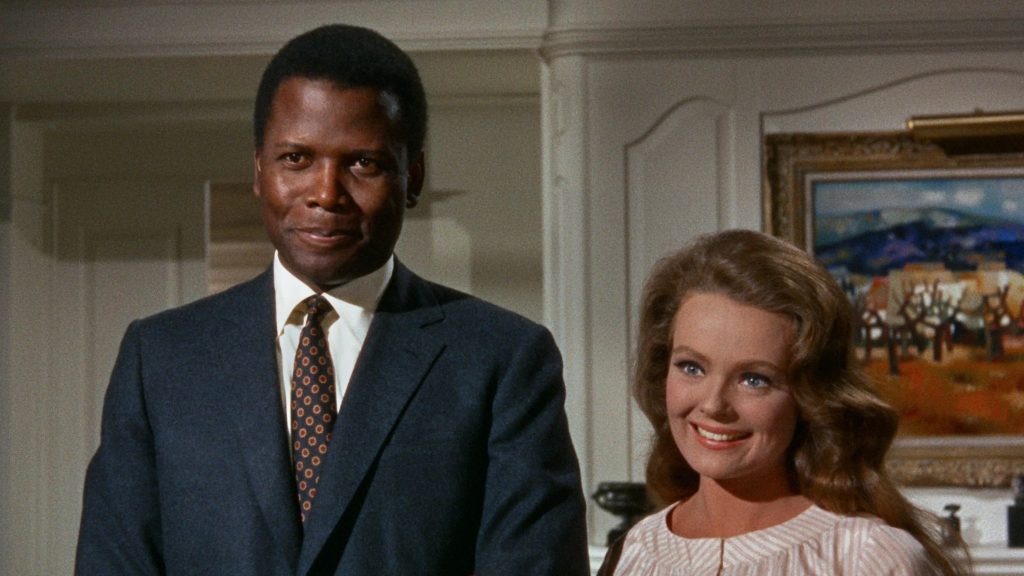
When Guess Who’s Coming to Dinner arrived in theaters in 1967, it did more than bring together four of Hollywood’s most recognizable stars. It placed one of America’s most divisive real-life issues directly in the middle of a familiar setting: the family dinner table.
Starring Spencer Tracy, Katharine Hepburn, Sidney Poitier, and Katharine Houghton, the film follows Joanna Drayton, a young white woman who introduces her fiancé, Dr. John Prentice, to her parents. The complication is immediately clear: John is Black, Joanna is white, and both families must confront their own assumptions about race, marriage, family, and acceptance.
Today, the premise may seem straightforward. In 1967, it was anything but.
A Film Released at a Turning Point in History
Guess Who’s Coming to Dinner was released only months after the U.S. Supreme Court’s landmark decision in Loving v. Virginia, which struck down laws banning interracial marriage across the country. Before that ruling, interracial marriage remained illegal in numerous states.
The film’s timing gave it an urgency that went far beyond entertainment. Americans were already living through a period of enormous cultural change shaped by the Civil Rights Movement, desegregation, protests, political conflict, and a growing national debate over equality. The movie asked audiences to consider a question that many families, communities, and institutions were still unwilling to discuss openly.
Rather than presenting interracial marriage as a distant political issue, director Stanley Kramer made it personal. The story is not built around a courtroom, a protest march, or a speech. It unfolds in a home, over one long and emotionally charged day.
That decision helped make the movie accessible to audiences who may have avoided a more confrontational film. The tension comes from conversations between parents and children, husbands and wives, and two families who must decide whether their ideals can survive when those ideals are tested in their own lives.
Sidney Poitier and a New Image of the Leading Man
The film also became an important chapter in the career of Sidney Poitier, one of the most influential actors in Hollywood history.
By 1967, Poitier had already become a major star, but that year placed him at the center of three significant films: To Sir, with Love, In the Heat of the Night, and Guess Who’s Coming to Dinner. Each film confronted issues of race in a different way, and together they made Poitier one of the most important screen presences of the era.
In Guess Who’s Coming to Dinner, Poitier’s Dr. John Prentice is portrayed as intelligent, accomplished, compassionate, and self-assured. He is a respected physician with a strong moral center. The film intentionally presents him as a man whose character cannot reasonably be dismissed or questioned.
That choice has been both praised and debated over the years. Some critics have argued that the character is written almost too perfectly, as though the movie felt it had to make John extraordinary in order for audiences to accept the relationship. Others see that portrayal as part of the film’s strategy: it forced viewers to recognize that prejudice is not about the qualities of the individual being judged, but about the assumptions people bring with them.
Either way, Poitier’s performance remains central to the film’s power. He does not play John as a symbol alone. He gives him dignity, restraint, frustration, intelligence, and emotional depth.
Spencer Tracy’s Final Performance
For many viewers, Guess Who’s Coming to Dinner is also remembered as Spencer Tracy’s final film appearance.
Tracy plays Matt Drayton, Joanna’s father, a man who sees himself as liberal and progressive until his daughter’s relationship forces him to confront the limits of his own beliefs. His performance gives the film much of its emotional weight, particularly as Matt struggles between the values he has publicly defended and the fears he feels privately.
The role became especially poignant because Tracy died shortly after filming was completed. His final scenes with Katharine Hepburn carry an added emotional resonance, particularly because the two had shared one of Hollywood’s most celebrated off-screen and on-screen partnerships.
Hepburn later received the Academy Award for Best Actress for her performance as Christina Drayton. Her character serves as one of the film’s strongest moral voices, refusing to allow fear or social pressure to overpower compassion.
Why the Film Still Matters
More than five decades later, Guess Who’s Coming to Dinner remains a film people return to not because it offers every answer, but because it captures the discomfort of change.
The movie is very much a product of its time. Its polished style, carefully constructed dialogue, and idealized characters reflect the Hollywood of the late 1960s. Yet its central question remains recognizable: What happens when people are asked to live by the values they claim to believe in?
The film understands that prejudice is not always loud or obvious. Sometimes it appears in hesitation. Sometimes it hides behind concern, tradition, or the fear of what others may think. Sometimes it exists in people who genuinely consider themselves fair-minded.
That is what gives Guess Who’s Coming to Dinner its lasting cultural significance. It does not simply ask whether two people should be allowed to marry. It asks whether love, family, and personal conviction can overcome the boundaries society has built.
For audiences in 1967, that question was urgent and controversial. For audiences today, the film remains a reminder that cultural progress often begins with difficult conversations—sometimes in public, sometimes in private, and sometimes around a dinner table.
Watch Guess Who’s Coming to Dinner on NOST and revisit one of classic Hollywood’s most memorable conversations about family, change, and the courage to examine one’s own beliefs.