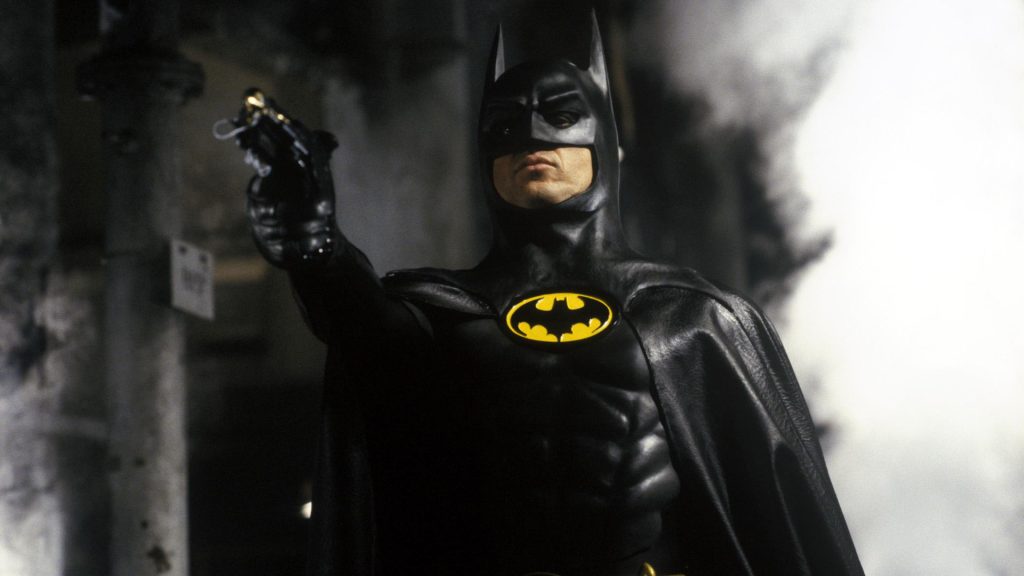
When Batman arrived in theaters in 1989, it presented Gotham City not as a brightly colored playground but as a shadowy urban nightmare. Tim Burton’s film helped demonstrate that a comic-book adaptation could function simultaneously as fantasy, crime drama, gothic spectacle and major Hollywood event.
Michael Keaton stars as Bruce Wayne, a wealthy and emotionally guarded man whose public identity conceals his life as the masked vigilante Batman. Jack Nicholson portrays Jack Napier, a criminal transformed into the Joker after a confrontation at a chemical plant. Kim Basinger plays photojournalist Vicki Vale, whose investigation of Gotham’s mysterious crimefighter brings her into the conflict between the two men.
Directed by Burton from a screenplay credited to Sam Hamm and Warren Skaaren, Batman was produced by Jon Peters and Peter Guber. The film was photographed by Roger Pratt, edited by Ray Lovejoy and designed by Anton Furst. It was primarily filmed at Pinewood Studios in England.
Casting Keaton was considered an unusual choice. He was best known for comedy and eccentric character roles rather than conventional action heroes. Burton’s approach, however, did not depend upon Bruce Wayne appearing to be an invulnerable physical giant. Keaton presents him as an unsettled, private figure whose wealth and social status cannot erase the trauma governing his life.
His restraint provides a contrast to Nicholson’s Joker. Napier treats murder, destruction and public terror as forms of performance. He does not merely want control of Gotham; he wants an audience. Nicholson moves between menace and theatrical comedy, making the Joker appear capable of turning any location into a stage.
The film also gives unusual attention to the similarity between hero and villain. Both Batman and the Joker construct identities through costumes, symbols and dramatic entrances. Neither man is satisfied with remaining anonymous. Each understands the psychological power of an image.
Gotham City is the environment that makes those competing images possible. Anton Furst’s production design combines towering buildings, industrial machinery, gothic architecture and crowded urban spaces. The city seems to have grown upward without planning, producing streets that are both monumental and claustrophobic.
That design received the Academy Award for Art Direction, awarded to Furst and set decorator Peter Young. The recognition confirmed that the film’s environment was not simply background decoration. Gotham’s architecture shapes the mood of nearly every sequence and became one of the production’s most influential achievements.
Danny Elfman’s music gives the film another defining element. The score provides Batman with a sense of grandeur while preserving the darkness and unease of Burton’s images. The film’s visual and musical identities worked together to make the character feel mythic without separating him entirely from the crime-ridden city he patrols.
Burton had previously directed Pee-wee’s Big Adventure and Beetlejuice, films that revealed his attraction to outsiders, unusual environments and macabre humor. Batman gave him a much larger canvas. His Gotham retained the distorted architecture and darkly comic energy associated with his earlier work while delivering the action expected from a summer blockbuster.
The British Film Institute has identified Burton’s Batman as an important step in the development of the modern superhero movie. Its darker interpretation of Bruce Wayne, the then-controversial selection of Keaton and Nicholson’s uninhibited Joker helped move the genre away from the lighter screen versions many viewers associated with the character.
The movie also became a cultural event beyond the theater. The black-and-gold bat emblem appeared across posters, clothing, toys and advertisements, often without requiring a title. As with Batman himself, the symbol became the message.
Later filmmakers would take comic-book movies in more realistic, interconnected and technologically elaborate directions. Yet Burton’s film remains a crucial dividing line. It proved that superheroes could inhabit worlds shaped by distinctive directors and production designers rather than neutral studio formulas.
Batman endures because it is not merely a story about a hero stopping a villain. It is a contest over who will define Gotham’s identity: the figure who uses fear to protect the city or the one who transforms terror into entertainment.
Director: Tim Burton
Starring: Michael Keaton, Jack Nicholson and Kim Basinger
Released: 1989
Rating: PG-13