The Color Purple begins in a world where Celie has almost no control over her own life. Over the course of the film, she discovers that endurance is not the same as surrender—and that finding one’s voice can become an act of liberation.
Set in the American South during the first half of the 20th century, the film follows Celie from adolescence into adulthood. Separated from her sister Nettie and trapped in an abusive marriage, Celie learns to survive by remaining quiet and unnoticed. Her understanding of herself gradually changes through her relationships with other women, including the fiercely independent Sofia and the glamorous singer Shug Avery.
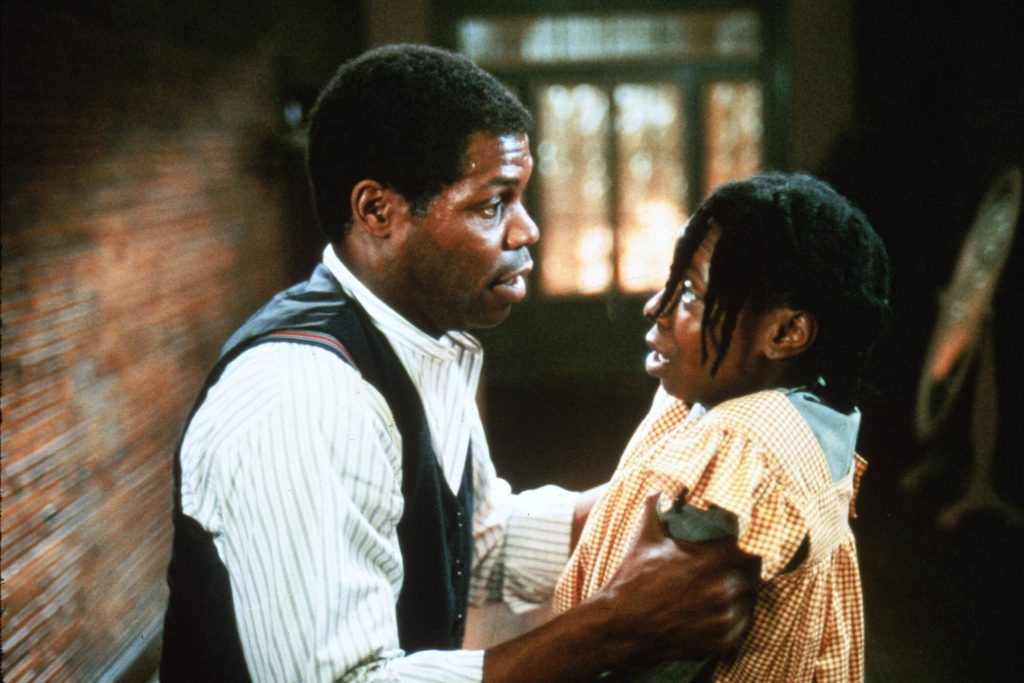
Released in December 1985, The Color Purple was directed by Steven Spielberg and adapted by Menno Meyjes from Alice Walker’s acclaimed 1982 novel. Spielberg also produced the film with Kathleen Kennedy, Frank Marshall and Quincy Jones. Whoopi Goldberg portrays Celie, with Danny Glover as Albert, Margaret Avery as Shug and Oprah Winfrey as Sofia.
Goldberg’s performance is built as much around observation as dialogue. Celie has spent years being discouraged from expressing anger, ambition or desire. Goldberg communicates that history through physical restraint, carefully controlled expressions and moments in which Celie seems to make herself smaller in the presence of others.
As the story develops, small changes become significant. Celie begins looking people directly in the eye. She permits herself to laugh, question and eventually resist. Her transformation does not occur because one person rescues her. It develops through relationships, discoveries and the growing realization that the cruelty she has experienced does not define her worth.
Oprah Winfrey brings tremendous force to Sofia, whose refusal to accept domination initially appears to make her Celie’s opposite. Sofia speaks openly, fights back and demands respect. Her story also demonstrates the danger faced by a Black woman who refuses to submit to the racial and social hierarchy surrounding her. Winfrey’s performance moves from physical confidence to profound vulnerability without diminishing the character’s essential strength.
Margaret Avery’s Shug introduces Celie to another way of living. Shug is confident, worldly and imperfect. She initially appears to possess the freedom Celie lacks, but she also carries personal wounds and unresolved family pain. The bond between the two women gives Celie affection, encouragement and an opportunity to imagine a different future.
Alice Walker was initially cautious about allowing Hollywood to adapt her Pulitzer Prize- and American Book Award-winning novel. According to the American Film Institute, Walker was concerned about the industry’s treatment of women and African Americans but chose to participate in the process rather than remain entirely outside it.
The film’s visual world contrasts hardship with moments of remarkable beauty. Rural landscapes, fields, flowers and changing seasons provide reminders that Celie’s life contains possibilities beyond the walls of her home. Allen Daviau’s cinematography gives the story an expansive quality, while the music associated with Quincy Jones helps connect its intimate emotions to a larger sense of community and spiritual renewal.
The title itself suggests that beauty can be present even when people have been conditioned not to notice it. Throughout the film, color, music and nature gradually become connected to Celie’s awakening. She begins to understand that joy is not something reserved for others.
The Color Purple received 11 Academy Award nominations, including Best Picture, Best Actress for Goldberg and supporting-actress nominations for Avery and Winfrey. It was also recognized for its screenplay, cinematography, production design, costumes, makeup, music and original song.
Its lasting power comes from the movement at the center of Celie’s life: from silence to expression, isolation to community and fear to independence. The film does not minimize the pain she has endured. Instead, it insists that a person’s identity can become larger than the suffering imposed upon her.
The Color Purple is ultimately a story about the families people are born into, the relationships they build and the courage required to claim a life of their own.
Director: Steven Spielberg
Starring: Whoopi Goldberg, Danny Glover, Oprah Winfrey and Margaret Avery
Released: 1985
Rating: PG-13